Choosing the method
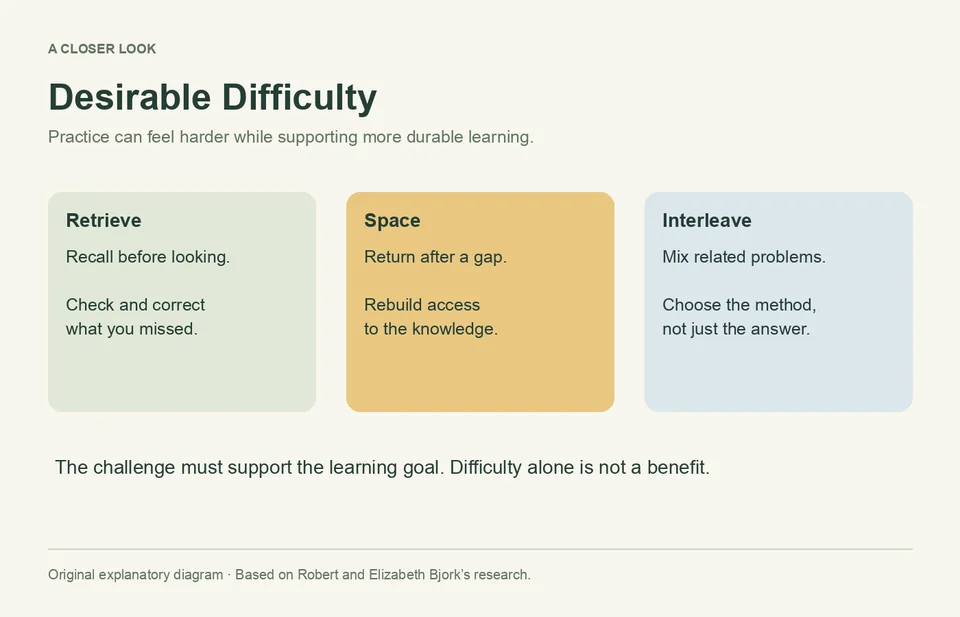
Mixed practice makes the learner identify which approach a problem calls for. A blocked set can make that choice implicit because every problem uses the same method.
Idea · A CLOSER LOOK
ABOUT THIS IDEA
Blocked practice groups one problem type together. Interleaving mixes related types, requiring you to discriminate between them and select an approach. That is different from switching attention between unrelated tasks.
For example, after learning several mathematical methods, mix problems that call for different methods. Decide which one fits before calculating. The benefit depends on the material and the learner; mixing is not automatically better for every task.
A CLOSER LOOK
Learn to choose the approach, not only to carry out a familiar sequence.
Mixed practice makes the learner identify which approach a problem calls for. A blocked set can make that choice implicit because every problem uses the same method.
Alternating related problem types or examples makes differences between them relevant. The practice includes discrimination as well as execution.
START HERE
Bjork Lab · learning research (opens in a new tab)Source for Interleaving: Bjork Lab · learning research.
Follow the original source to explore the work in its own context.
Introductions are grounded in the sources below. Collection notes and reading prompts provide an editorial starting point; personal opinions are identified in the collection’s content.
KEEP EXPLORING